
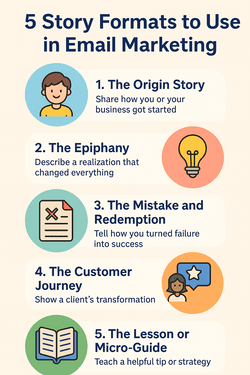
5 Story Formats to Use

Infographic titled “5 Story Formats to Use in Email Marketing,” visually representing five formats — Origin Story, Epiphany, Mistake & Redemption, Customer Journey, and Micro-Guide — with icons and color-coded sections.

📚 5 Story Formats to Use in Email Marketing

If you’ve got the structure down (Hook → Conflict → Journey → Solution → CTA), the next question is: What kind of stories should you tell?

That’s what this post is about — 5 plug-and-play story formats you can use to fill your emails with trust, relatability, and conversion power.

Whether you’re writing from scratch, using ChatGPT, or repurposing PLR (like Liz Tomey’s funnel kits), these formats make email storytelling fast and effective.


🧒 1. The Origin Story

Everyone loves a “where I came from” story. This format shows your journey, builds credibility, and connects with your reader on a human level.

Use it for: Welcome emails, first-time promos, affiliate intros

Example: “I used to waste hours on dead-end traffic. Then I discovered a smarter way…”


💡 2. The Epiphany

This is the “Aha!” moment that changed everything. Great for introducing a tool, tactic, or belief shift that helped you (or someone else).

Use it for: Product launches, one-off promos, mindset emails

Example: “The moment I realized my list didn’t need to be big — it needed to be loyal…”


❌ 3. The Mistake and Redemption

This format builds trust through vulnerability. Admit a mistake, share the pain, then show how you fixed it (and how they can too).

Use it for: Bridge emails, follow-up sequences, soft sales

Example: “I burned my list with hype. Here’s how I fixed it and what I send now instead…”


🙋 4. The Customer Journey

These stories show what someone else achieved using your product or system. Even if it’s fictionalized (like in PLR), it paints a picture of transformation.

Use it for: Testimonials, case studies, re-engagement sequences

Example: “Jenny started with 0 subscribers. Now she makes $250/week from one funnel…”


📘 5. The Lesson or Micro-Guide

Teach something quick and useful. Wrap it in a story or mini-experience. Great for positioning you as a helpful, non-pushy guide.

Use it for: Nurture emails, email courses, lead magnet follow-ups

Example: “This one subject line got me a 42% open rate — here’s why it worked…”


🛠️ How to Use These Story Formats with ChatGPT

Try prompts like:


“Write an origin story email for a new affiliate using the 5-part structure”  
“Turn this bullet list into a micro-guide email that sells without selling”  
“Rewrite this PLR promo as a ‘redemption story’ style email”  

Then polish it in your voice — or better yet, train ChatGPT to write in your style over time.


✅ Final Thoughts

You now have the structure AND the story formats to power up your email marketing — without starting from scratch every time.

Use these templates with your own experiences, with PLR like Liz Tomey’s prebuilt funnels, or blend both using ChatGPT.

👉 Next up in the series: ChatGPT Prompts to Write Better Emails (Faster)


Want step-by-step help building your own online business? Check out my favorite platform below.

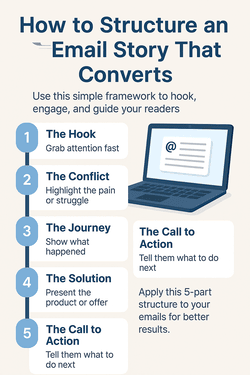
How to Structure an Email Story That Converts

Infographic titled “How to Structure an Email Story That Converts,” outlining five key elements: Hook, Conflict, Journey, Solution, and CTA.

📐 How to Structure an Email Story That Converts

Storytelling works — but only when it’s structured the right way.

Without a clear beginning, middle, and end, your email can fall flat. Or worse… confuse your readers and kill your conversions.

This post gives you a plug-and-play framework to structure any story-driven email — whether you’re writing from scratch or repurposing PLR with ChatGPT.


🧱 The Simple 5-Part Email Story Framework

Use this for promos, broadcasts, onboarding — any time you want attention, engagement, and action.

  1. 1. The Hook (Subject + 1st Line)
    Capture attention fast. Use curiosity, contradiction, or a bold emotional statement.
  2. 2. The Conflict
    What’s the pain, struggle, or obstacle? Make it relatable. It’s the heart of your story.
  3. 3. The Journey
    Show what happened. The mistake you made. The “aha” moment. Keep it conversational.
  4. 4. The Solution
    What helped? Introduce the product, tool, or shift that changed things.
  5. 5. The Call to Action
    Tell them what to do next — with urgency or intrigue. Link it up.

✍️ Quick Example

Subject: I almost quit… until this changed everything

I was ready to throw in the towel. Nothing was working, and I felt like a fraud.

But then I saw what other successful marketers were doing differently. They were telling stories.

Now I use this tool to write story-driven emails fast — and my list is actually opening them. Want to see how it works? 👉 [Link to offer or blog post]

See? Short, punchy, emotional — but still structured.


🤖 Use ChatGPT to Build the Framework

Try a prompt like:


“Write a short email promoting a PLR funnel using this format:
1) Hook
2) Conflict
3) Journey
4) Solution
5) CTA”

Or better yet — plug in Liz Tomey’s PLR funnels and rewrite them using this flow.

You get the speed of done-for-you content… with the connection of a custom-written story.


🔁 Make It Repeatable

Use this structure for:

  • 🧲 Welcome emails
  • 📢 Promotions and product launches
  • 📬 Broadcasts with soft CTAs
  • 📚 Lessons and personal stories

The more you use it, the faster you’ll write. The better your emails perform. The more your list trusts your voice.


📬 Final Thoughts

Structure gives your stories power. And now you’ve got a repeatable format that works for any niche, any audience, and any offer.

👉 Next up: 5 Story Formats to Use in Email Marketing

Until then — tell your story. Structure it right. And watch your readers stick around (and click).


Want step-by-step help building your own online business? Check out my favorite platform below.