
📐 How to Structure an Email Story That Converts
Storytelling works — but only when it’s structured the right way.
Without a clear beginning, middle, and end, your email can fall flat. Or worse… confuse your readers and kill your conversions.
This post gives you a plug-and-play framework to structure any story-driven email — whether you’re writing from scratch or repurposing PLR with ChatGPT.
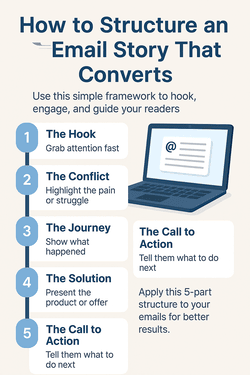
🧱 The Simple 5-Part Email Story Framework
Use this for promos, broadcasts, onboarding — any time you want attention, engagement, and action.
- 1. The Hook (Subject + 1st Line)
Capture attention fast. Use curiosity, contradiction, or a bold emotional statement. - 2. The Conflict
What’s the pain, struggle, or obstacle? Make it relatable. It’s the heart of your story. - 3. The Journey
Show what happened. The mistake you made. The “aha” moment. Keep it conversational. - 4. The Solution
What helped? Introduce the product, tool, or shift that changed things. - 5. The Call to Action
Tell them what to do next — with urgency or intrigue. Link it up.
✍️ Quick Example
Subject: I almost quit… until this changed everything
I was ready to throw in the towel. Nothing was working, and I felt like a fraud.
But then I saw what other successful marketers were doing differently. They were telling stories.
Now I use this tool to write story-driven emails fast — and my list is actually opening them. Want to see how it works? 👉 [Link to offer or blog post]
See? Short, punchy, emotional — but still structured.
🤖 Use ChatGPT to Build the Framework
Try a prompt like:
“Write a short email promoting a PLR funnel using this format:
1) Hook
2) Conflict
3) Journey
4) Solution
5) CTA”
Or better yet — plug in Liz Tomey’s PLR funnels and rewrite them using this flow.
You get the speed of done-for-you content… with the connection of a custom-written story.
🔁 Make It Repeatable
Use this structure for:
- 🧲 Welcome emails
- 📢 Promotions and product launches
- 📬 Broadcasts with soft CTAs
- 📚 Lessons and personal stories
The more you use it, the faster you’ll write. The better your emails perform. The more your list trusts your voice.
📬 Final Thoughts
Structure gives your stories power. And now you’ve got a repeatable format that works for any niche, any audience, and any offer.
👉 Next up: 5 Story Formats to Use in Email Marketing
Until then — tell your story. Structure it right. And watch your readers stick around (and click).
Want step-by-step help building your own online business? Check out my favorite platform below.